
REQUEST DOCUMENTS
HOME > REQUEST DOCUMENTS > Applying LC–MS to gRNA Impurity Control: Quantification of Poorly Resolved Species
Applying LC–MS to gRNA Impurity Control: Quantification of Poorly Resolved Species
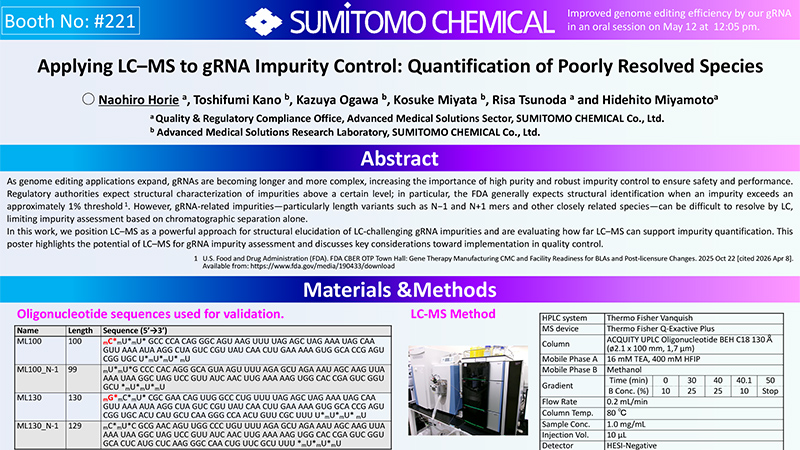
- As genome editing expands, gRNAs are becoming longer and more complex, making high purity and robust impurity control essential. Regulators generally expect structural identification for impurities above ~1%, yet gRNA-related impurities such as N−1/N+1 length variants and closely related species can be poorly resolved by LC, limiting assessment by chromatography alone. Here, using ~100–130 mer gRNAs, we present LC–MS as a powerful approach to elucidate LC-challenging impurities and evaluate how far it can support impurity quantification. Key considerations for QC implementation are discussed.
Require This Document
- By using this website, you agree to abide by the Terms of Use of the Sumitomo Chemical Website.
- Information submitted through this website will not be used for any purpose other than replying to inquiries. For information regarding the protection of personal information, please read Sumitomo Chemical's Privacy Policy.