
REQUEST DOCUMENTS
HOME > REQUEST DOCUMENTS
-
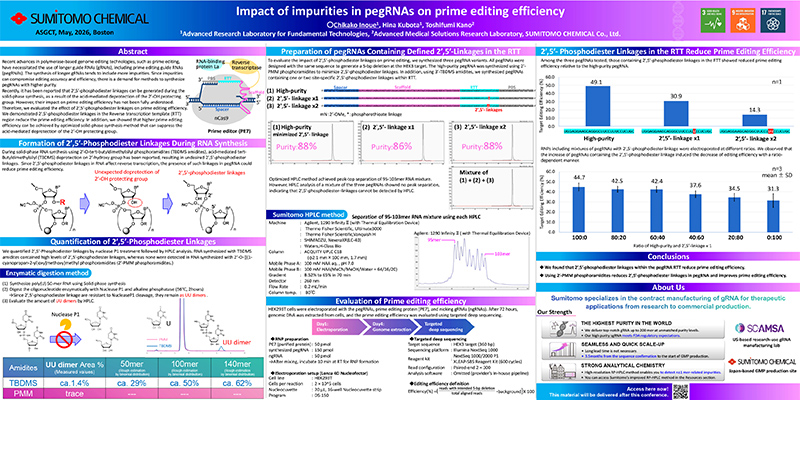
Impact of impurities in pegRNAs on prime editing efficiency
This document presents our findings from the 2026 American Society of Gene & Cell Therapy (ASGCT) Annual Meeting on how 2’,5’-linkage impurities generated during the synthesis of prime editing guide RNA (pegRNA) affect prime editing efficiency. -
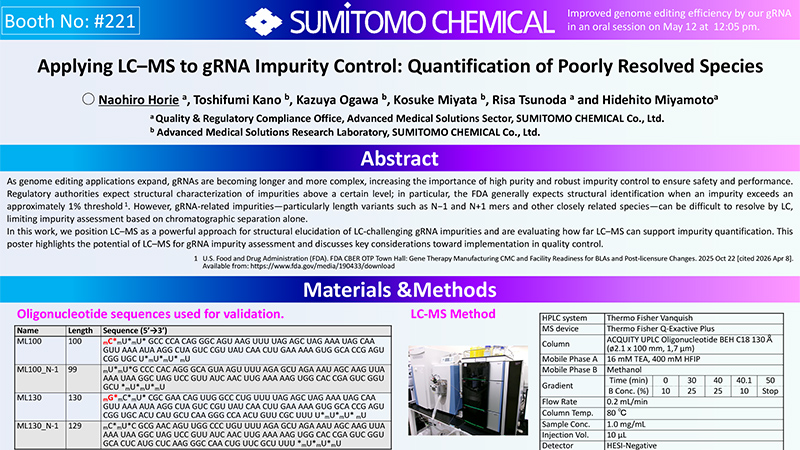
Applying LC–MS to gRNA Impurity Control: Quantification of Poorly Resolved Species
As genome editing expands, gRNAs are becoming longer and more complex, making high purity and robust impurity control essential. Regulators generally expect structural identification for impurities above ~1%, yet gRNA-related impurities such as N−1/N+1 length variants and closely related species can be poorly resolved by LC, limiting assessment by chromatography alone. Here, using ~100–130 mer gRNAs, we present LC–MS as a powerful approach to elucidate LC-challenging impurities and evaluate how far it can support impurity quantification. -
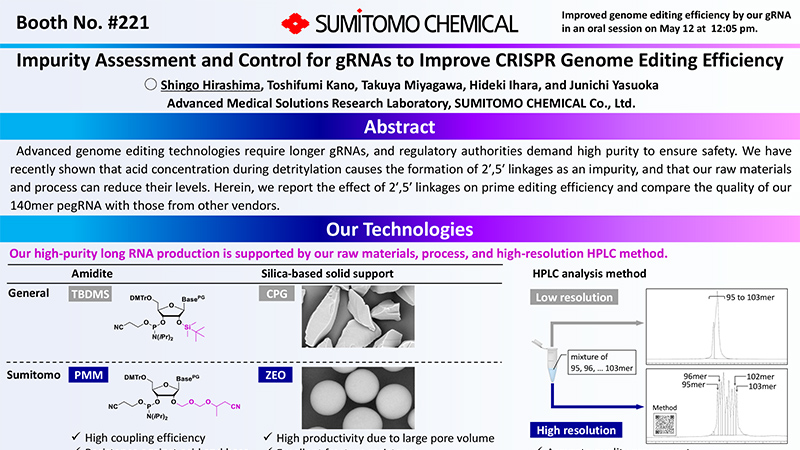
Impurity Assessment and Control for gRNAs to Improve CRISPR Genome Editing Efficiency
This poster reports that suppressing a specific impurity that is difficult to detect in oligonucleotide analysis is important for improving genome editing efficiency. -
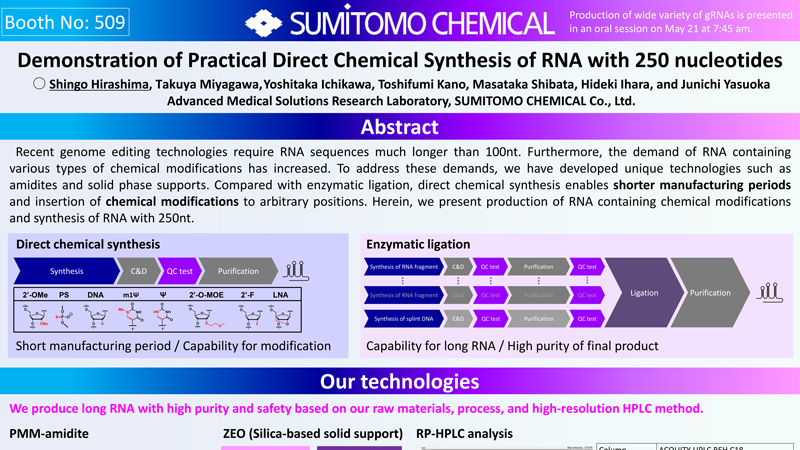
Demonstration of Practical Direct Chemical Synthesis of RNA with 250 nucleotides
The document highlights further advancements in RNA synthesis, focusing particularly on the challenge of producing longer RNA sequences. -
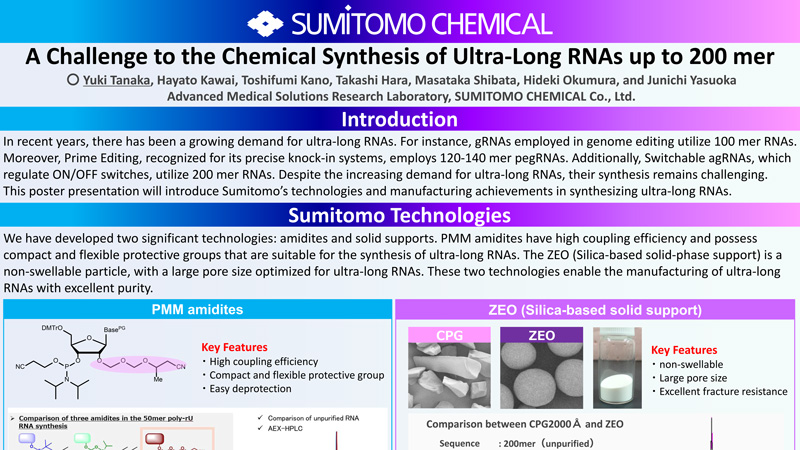
A Challenge to the Chemical Synthesis of Ultra-Long RNAs up to 200 mer
This document introduces Sumitomo's advancements in synthesizing ultra-long RNAs, essential for fields like genome editing and Prime Editing. -

HAA-based Ion Pair Reversed Phase HPLC Method for More Accurate gRNA Purity Test
This document titled "HAA-based Ion Pair Reversed Phase HPLC Method for More Accurate gRNA Purity Test," is derived from the poster presented at ASGCT in May 2024. -

Chemical Synthesis of High Quality RNAs with a Length of 200 mer
This document, titled "Chemical Synthesis of High Quality RNAs with a Length of 200 mer", highlights thethe excellence of Sumitomo's process for producing high-quality 200mer guide RNAs (gRNA), -

Sumitomo's Newly Developed RP-HPLC Method for 200 mer gRNAs
The document, "Sumitomo's Newly Developed RP-HPLC Method for 200 mer gRNAs", draws from the poster presented at TIDEs USA in May 2023 and highlights the new RP-HPLC method tailored for 200 mer gRNAs. -

RP-HPLC Analytical Method for gRNAs
The document titled "RP-HPLC Analytical Method for gRNAs" outlines our standard RP-HPLC analytical method, facilitating accurate purity measurements of guide RNAs (gRNA).